25 June 2012


WHAT CONSTITUTES A PROPER PLANET
by Ashley Capps


I decided to drive to the beach, where I sat in the sand and dug a large hole.

There was a tiny translucent crab with eyes like my mother

and such a specific inner life I tossed it fast back into the tide.

The sop I scooped out made a kind of wall which slid in on itself if my pace slackened.

I had to dig quicker. I dug frantic. Kids appeared with plastic buckets, little shovels—

I wanted to ask them not to collapse it, but they hung back, a cautious tribe.

Till at last, one poked me with a stick, and asked why I was doing that.

And I said, "To keep the ocean out." And then they all joined in.

08 June 2012

What a Cute Picture!


Why hasn't this spurred on a RomCom or CBS television series? 

31 May 2012

This poem came to mind

I was wondering around the Idaho countryside, a rural area with old barns and houses, and this Creeley poem snuck into me.


Somewhere

The galloping collection of boards   
are the house which I afforded   
one evening to walk into
just as the night came down.

Dark inside, the candle
lit of its own free will, the attic   
groaned then, the stairs
led me up into the air.

From outside, it must have seemed   
a wonder that it was
the inside he as me saw
in the dark there.


30 May 2012

Amazon Pseudo-Scholars?


For all of Amazon’s faults, and there are many, the review portions often lead to entertaining insights. Some people feel very comfortable making broad declarations and judgments in that forum, which strikes me as strange because elsewhere (readings, workshops, conferences, etc.) that dynamic seems to get tempered. So, while I disagree with much of what’s written, the Amazon reviews at least provide something a little different.

Here’s one regarding the Merwin translation of Osip Mandelstam, written by Donald A. Newlove:

“I like Merwin's Mandelstam more than that of five other translators with whom I've compared Mandelstam translations. It often takes three readings of a Mandelstam poem to get why it was written---not what it is about, please---but WHY it was written. That is what you look for. After that the sense of the poem will appear.”

Mr. Newlove claims to have found the right formula for reading poems. You have to admire the cringe-worthy brashness of “that is what you look for,” as if there were only one definite way to read poetry. But that’s not my main source of entertainment. What I really love is the last sentence in this quote, which treats poetry like a magic trick; the meaning of the poem is like the woman who disappeared behind the curtain only to return—or maybe it’s the clichéd rabbit that gets pulled out of the hat. But, remember, you MUST read the poem three times for the trick to work! 

01 May 2012

Vitae Summa Brevis Spem Nos Vetat Incohare Longam
by Ernest Dowson

The brief sum of life forbids us the hope of enduring long. –Horace

They are not long, the weeping and the laughter, 
Love and desire and hate: 
I think they have no portion in us after 
We pass the gate. 

They are not long, the days of wine and roses: 
Out of a misty dream 
Our path emerges for a while, then closes 
Within a dream.

02 April 2012

John Winthrop's City upon a Hill speech, 1630


Now the onely way to avoyde this shipwracke and to provide for our posterity is to followe the Counsell of Micah, to doe Justly, to love mercy, to walke humbly with our God, for this end, wee must be knitt together in this worke as one man, wee must entertaine each other in brotherly Affeccion, wee must be willing to abridge our selves of our superfluities, for the supply of others necessities, wee must uphold a familiar Commerce together in all meekenes, gentlenes, patience and liberallity, wee must delight in eache other, make others Condicions our owne rejoyce together, mourne together, labour, and suffer together, allwayes haveing before our eyes our Commission and Community in the worke, our Community as members of the same body, soe shall wee keepe the unitie of the spirit in the bond of peace, the Lord will be our God and delight to dwell among us, as his owne people and will commaund a blessing upon us in all our
wayes, soe that wee shall see much more of his wisdome power goodnes and truthe then formerly wee have beene acquainted with, wee shall finde that the God of Israell is among us, when tenn of us shall be able to resist a thousand of our enemies, when hee shall make us a prayse and glory, that men shall say of succeeding plantacions: the lord make it like that of New England: for wee must Consider that wee shall be as a Citty upon a Hill, the eies of all people are uppon us; soe that if wee shall deale falsely with our god in this worke wee have undertaken and soe cause him to withdrawe his present help from us, wee shall be made a story and a byword through the world, wee shall open the mouthes of enemies to speake evill of the wayes of god and all professours for Gods sake; wee shall shame the faces of many of gods worthy servants, and cause theire prayers to be turned into Cursses upon us till wee be consumed out of the good land whether wee are going: And to shutt upp this discourse with that exhortacion of Moses that faithfull servant of the Lord in his last farewell to Israell Deut. 30. Beloved there is now sett before us life, and good, deathe and evill in that wee are Commaunded this day to love the Lord our God, and to love one another to walke in his wayes and to keepe his Commaundements and his Ordinance, and his lawes, and the Articles of our Covenant with him that wee may live and be multiplyed, and that the Lord our God may blesse us in the land whether wee goe to possesse it: But if our heartes shall turne away soe that wee will not obey, but shall be seduced and worshipp other Gods our pleasures, and proffitts, and serve them, it is propounded unto us this day, wee shall surely perishe out of the good Land whether wee passe over this vast Sea to possesse it;
Therefore lett us choose life,

that wee, and our Seede,

may live; by obeyeing his
voyce, and cleaveing to him,
for hee is our life, and
our prosperity.

23 March 2012

Curriculum Vitae by Alissa Valles


I was born in mid-winter.
A bird obscured the sun.
It was a public holiday:
rubbish stood uncollected
in the streets of the capital.
Soldiers sat smoking
around mountain fires.
My mother wore red,
the doctors wore white,
my father came running.
My education proper
began when my uncle
fell into my room, nude
but for a tumbler of whiskey.
I kissed his knees and feet.
From then on, it was one
mad success after another:
the first of my sex allowed to
do rifle training, prizes
in ethnic understanding.
An artist I posed for said
a woman worth painting
looks clumsy in a dress.
At graduation, I recited
and I long and yearn
bringing tears to many eyes.
I believe I am suitable for
the position of his majesty’s
concubine for several reasons.
I rarely speak: since I left
school, I’ve spoken only
to decline marriage offers.
I rarely weep: once, when
my son was taken away.
It’s said the emperor likes
games of flight and pursuit.
If I may say so, without
being thought immodest,
I’m an accomplished prey.

21 March 2012

Goodbye Shawn Kemp Carwash

Shawn Kemp Carwash began on 15 March 2011. Today is 21 March 2012. I took my car to the wash this afternoon but did not smoke pot (ala Shawn Kemp) while inside. As my final SKC post, here is a picture of that experience. Goodbye:

20 March 2012

The Broken Gaze, by Paul J. Leslie, III

Every salesperson at least one point in their career has been asked about their competition by a customer. It never looks good to a customer when you talk bad about your competitors. When you use The Broken Gaze you will be able to say nice things about the competition that your customer will perceive as negatives without you ever saying or expressing it.

1. You must be in excellent rapport with good eye contact with your customer from the beginning.

2. When the customer asks about your competitor, break the eye contact and slightly lower your voice.

3. When you are done talking about them instantly re-establish eye contact and previous voice patterns.

For example:

You and Mrs. Smith are talking about the fine washer and dryers your store sells. You are in good rapport and have anchored `quality and dependability' to yourself. You have excellent eye contact. She then asks about Jones Washers, who are down the street. You immediately break your eye contact and slightly lower your voice and say, "I have heard that there are nice people down at Jones". You immediately reconnect your eye contact and bring back your voice pattern to normal to tell Mrs. Smith about your free delivery offer. If she asks later about Jones Washers you try the same approach. Her brain will link losing rapport to Jones Washers, so it doesn't matter what they offer she will feel disconnected to the competition.

You have succeeded in your sale without bashing anyone.

12 March 2012

The Flasher

SKC's Jeff Alessandrelli discusses baths and flashing in a good review of Adam Peterson's new book over on HTMLGIANT.

07 March 2012

Ghosts

First Second Song

Clyfford Still Museum


Although not as well known as Jackson Pollock, Mark Rothko, or Robert Motherwell, Clyfford Still was part of the first generation of Abstract Expressionists, all of whom employed expressive brush work upon canvases that were large in scale, more often than not meant to convey the grand human narratives of life and death etc.

Still died in 1980 and, subsequently, over 2,400 of his works (approximately 94% of his output as a professional artist) were kept from public viewing until, in accordance with his will, a permanent home for them was built to house them exclusively.

Denver, CO won the bid and the two-story, 28,500 square foot museum officially opened in November of 2011. It is located next to the Denver Art Museum.

Below is an image of the Still paintings PH-4, 1952 and PH-1060, 1954:

Photobucket

06 March 2012

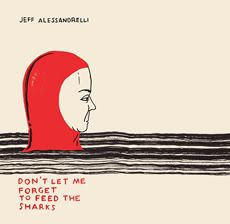
Don't Let Me Forget To Feed The Sharks

Bro has a new chapbook called Don't Let Me Forget To Feed The Sharks out on the Poor Claudia imprint; it's wicked sweet and shit. You can purchase it here.

$1000 Atheist Poem

I'd encourage anyone who is an atheist and reads this blog to enter Bill Knott's $1000 Atheist Poetry contest. Info below.

PLEASE CONSIDER SUBMITTING POEMS TO THIS BLOGANTHOL:

http://atheistpoetryblog.blogspot.com//

Cash prize: one thousand dollars will be awarded for the best new anti-religious poem
submitted/accepted/posted on this blog in the year 2012.
(No entry fee, judging will end December 1st.)

Triggermoon Triggermoon

"What have I done to this world" (9), asks the speaker of "There Was a Bridge of Tattered Rugs," which is the opening poem of Julia Cohen's Triggermoon Triggermoon (Black Lawrence Press, 2011). She poses the question, it would appear, in response to the series of images that precede it: "A nightgown soaked in milk / The bassinet in the greenhouse / A boat-shaped spider crabbing the high corner." The world she creates, the one she questions, is a world populated by images slightly askew, each separated by (oftentimes) large associative leaps.

These poems, then, alter our world to the extent that it becomes a "non-world" that "occasionally rolls over" us, producing "Birdsongs [that] appear as abstract patterns" (14). But if we are to piece together something more than abstract patterns, we are told that our eyes must "darken to enliven the birdsong" (14) and form more concrete, visible images. I can only assume that to darken our eyes, we must close them [1] and let the imagination (i.e. our mental imagery) take over.

Perhaps the poem that expresses this strange state the best, at least with regard to the rhetoric of its content, is the first section of "Hello, Goodly," which follows in its entirety:
When you practiced reading on the couch
in Rhode Island, it was the goodly sound

of the weekend

'I have trouble with my sentencing.'

It is true that I had woken up & may have
been disoriented.

It is also true that during moments

of sleepy confusion as we rise, time, with us
in it, has the most clarity.

It is when I am the most confident & the most
vulnerable—to sit by you & secretly water

your shoulder in the right way.

'Do you see the pear tree
growing between the couch cushions? (52)
Waking up in a "sleepy confusion," wherein the mind is still "disoriented," the speaker is both confident and vulnerable. The competing tensions in these moments (manifested in troubling sentences) create an amalgamation of fantastical imagery, such as a "pear tree / growing between couch cushions." A pear tree and a couch cushion, unto themselves, provide little in the way of the extraordinary; but when combined, they produce a "non-world" in which the "something living in these / lives I've not yet found" (47) is found.

[1] It's important to remember, though, that "When we shut out eyes they are actually still open only / covered by a lid" (60); in other words, just because our eyes are "closed," we do not detached from reality, merely interpret reality from a different, darker perspective.

This is what happens when you take the train from Chicago to Lincoln

Exquisite Corpse 1

When do we know the world’s ending?

There is a musty, quaint sense of possibility.

What does the silence of a fact resemble?

Shit it’s all shit. You drive by and smell shit.

So what kind are you?

A damp wind entering your pants.

Why do babies stay alive?

“Because I am lost without you.”

Furious trees resemble the touch. What do I say to

If you go sit under a tree it will hit you.

Where?

Behind the supermarket’s loading dock.

Who is the woman with the twitching cheek?

The decision was mine alone. Until.

What is the sense of sensation here?

June 17, 1965. The station wagon had fold down back seats.

And I’m still wondering how you came along.

By sitting still for a very long time.


Exquisite Corpse 2

Why is your face so unreal?

Because since then I’ve grown.

Pray tell me?

Because I painted it to fit the mood.

Where does the act of a play begin and the world end?

On your beautifully landscaped front lawn.

How do you know the meaning of life?

Through the keyhole. With a long steel rod. At night.

And when else would I?

Tomorrow.

The sky is pagan, taking shape before we realize. How does it do that tonight?

By smelling the milk to guess the animal.

Where does one find a decent meal?

Omaha. I drank it out of a cowboy boot.

Where the hell were you?

In heaven. In Paris. In Tucson. In the clouds. Remember me there. Stand still and firm.

05 March 2012

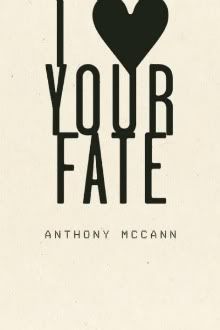
I ♥ Your Fate

The poem "Putin With Lynch" in Anthony McCann's book I ♥ Your Fate (Wave Books, 2011) functions, to my mind, as an ars poetica, offering readers some sense of how to read the collection:

But there's a parallel world attached to this world
Which are these paths drawn thinly down through the woods
And I meet you there now under the bridge
Where we hear the snow sing snow songs to itself (21)

McCann's poems, indeed, are parallel worlds where "the snow sing snow songs," which in turn allow us, through the confluence of sound and the imagination (i.e. the acoustic-image), to sing our own songs while reading each of them. "But there's a parallel world there under the snow," and in the parallel world below the world parallel to our world, there is "grass thinking snow thinking snow thinking snow" (21): a thought below worlds of song twice removed.

Perhaps the most compelling actualization of this idea poetic-concept-world occurs in the poem "In the Visitors' Locker Room." The poem begins:
Now imagine the vagina
Picture the unfolding of the
Buttery vulva

Picture the swollen wrinkly lips
The shiny pulsing clit (60)
There is the world of the reader (and writer), then there is the world parallel to that world in the poem and it's filled with an "unfolding... / Buttery vulva." The worlds stimulate a vision within the reader's mind: specific, clear, and isolated. But it is also a world attuned to (vagina) song in the internal rhyming of "imagine" and "vagina" and the half rhyme of "lips" and "clit," as well as the assonance of "Picture...wrinkly lips / ...shiny...clit." But, once in this world, we are asked to go elsewhere into another world:
And then picture the world

A parking lot
In the desert

Wind
The rumble and rattle of traffic
The day's last light
Darkness settling
Over the pumps

You are a traveler
You are entering
The glass cube
Of this Chevron station (60-61)
The abrupt shift between worlds is made all the more drastic through the juxtaposition of two disparate images: the close-up of a vagina contrasted against the desolate but panoramic Chevron station and its "parking lot / In the desert." The other shift, of course, is that the reader (i.e. "You") has enter the poem world; no longer a disembodied sexual organ, we now see ourselves actively participating:
Your hand is on the door handle
You are pulling open the door
The little bell is jingling

And you remember nothing else
Not where you are from
Nor where you are going (61)
This world, then, becomes so focused and so all-consuming that we no longer remember where we are from or where we are going. Likewise, the fact that our actions are so simple, contain such basic imagery, and are relatively innocuous enable most readers in the modernized world to connect with them. And just as we're settling into this new, banal, precise-but-less-than-overwhelming world:
So that this wonderful vagina
Has become even more appealing

And you can touch it with your nose
And you can wiggle your nose in it
And then you can kiss it (61)
We return to the vagina, but this time we are going down on it. One would assume, given the claim that we "remember nothing else" beside the Chevron station in a desert, the poem is having a bit of fun at our expense, or at least pulling us out of our modern petrol reverie and reminding us of our sexual longings; but moreover, reminding us that even while we're deep within one world, there is a parallel world existing alongside it, whether we think of it or not. And that world is filled with the repetitive songs of an "And you can" anaphora. But, yes, the worlds shift again:
Meanwhile in the world
A scraggly little animal passes
It scurries through the lot
All dust and twigs (62)
And then, another world within an already other world:
And on television
The one over the gas pumps
Kobe Bryant
Is talking about his father

He is speaking very slowly (62)
And then worlds begin to intersect and revelations present themselves to us:
And you listen very carefully

Which is when you learn

That the most important thing
in this game

is to win

this game

And that this

Kobe Bryant
Has never forgotten (62)
We figure that that game Kobe Bryant refers to is basketball, but what game must we win? And why has Kobe "never forgotten" this, but we can "remember nothing else" besides our hands pulling a door handle and little bells jingling? Why all these worlds? Not surprisingly, we are told:
Now you feel very confused
You will try to remember your own father (63)
But in this confusion [1], which includes a switch to the future tense, we have very little time to think of our fathers. Instead, we return to the desert parking lot:
As the animal disappears
in the scrub brush
beyond the dumpsters
and in the sky
a kind of gloaming
is happening

But you don't remember the word
and you would never say gloaming (63)
And now we know that the "You" of this poem, or at least the "You" of this parallel poem-world, might not actually be us because these words in this world we've never known and never care to use. You are not "You"; "You" is someone else that may or may not resemble you, but we are in the world and looking through "You's" eyes nonetheless. In all this confusion, then, we return to what we've seen most clearly and what we've longed to see once again, primal, clear, and lasting:
And you think again of the vagina
The marvelous vagina
The wrinkled bloom of the labia
The mute pulse of the clit

The night is not a mirror
This night is not the Void
It's a wonderful vagina
You've been standing here for years (63)
[1] It should also be noted, although formatting for Blogger makes it difficult, that the Kobe Bryant section is scattered about the page in a field/organic form, further maximizing the confusion.

28 February 2012

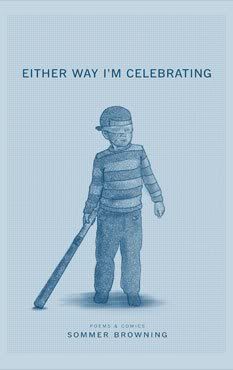
Either Way I'm Celebrating

"It's always strange to be born / before the cusp of some new age, / hanging onto nothing" (22), writes Sommer Browning in her book Either Way I'm Celebrating (Birds, LLC 2011). In some ways, I think this sums up the experience of reading this collection, at least to the extent that it's strange to be on the cusp of "the new," especially if you're predisposed to hang onto genre distinctions. By this, I mean that Browning's collection oscillates between comics, poems, flash fiction, and oblique notes to a housesitter. Given the alterations, its changes could be disconcerting if you're looking for familiarity; but if the prospect of variety sounds exciting to you, then Either Way I'm Celebrating makes for a fantastic read.

The opening series of poems works best when the speaker incorporates phrases that read like one-liners (as in jokes, not as in lines of poetry). Some of my favorite moments include: "I'm worried how many more times I'll tell the story / about peeing in a cop car before someone loves me" (18), "I collect books found in celebrities' bathrooms; so far / my life sucks" (19), and "um...you're going to make me say it? Your taint. Is it your taint?" (32). What all these excerpts have in common, I think, is a particular irreverence (at least in relation to most poetry) and a casual tone that makes the speaker sound both identifiable and believable. This characteristic is important because, when the speaker delivers her more grandiose statements such as "Sometimes, it's the world that's inadequate" (18) and "There is too, a galaxy in poetry" (19), we're willing to accept them from a voice we've come to trust.

In the second section of writing, we told a tale about a couple staying in a hotel to watch a UFC fight and visit a historical Whitman site. With its catalogs of the contemporary American landscape and consumerism, it reads like an update not just of Whitman, but also of Ashbery and Brainard's The Vermont Notebook (which itself was a Whitman re-write).

The final text portion of the book is titled "To the Housesitter," which, as previously mentioned, are a series of notes to someone who will be taking care of (you guessed it) a house. The notes create an ever strange and mutating house that "is as malleable as vocabulary" (86) by offering us both prose and verse, which turns the commonplace into linguistic novelties, such as a "dribbling refrigerator...shaped like mouths" (67).

Of course, the most prominent aspect of the Either Way I'm Celebrating are the comics; by turns witty and absurd, they provide visual respites before and after each section of text. My favorite (as well as indicative of the tone and aesthetic of the comics collectively) is the "Critique of Pure Reason":

Photobucket

I can't tell you exactly why someone stuffed a copy of Kant's Critique of Pure Reason into the middle of a sandwich, but what does that matter? The seemingly random gesture undercuts the inherent seriousness (some may say pretentiousness) of philosophy and those who choose to engage such subject matter. And it should also be pointed out that the black and white drawings, at least aesthetically, once again echo The Vermont Notebook and Brainard's charcoal drawings therein.

Finally, in the spirit of the collection, I'd like to share an experience I had when reading the poem "Empiricism" (Click image for detailed view):

Photobucket


Kemp Sorta Disses Griffin

Today on SI.com, there a link to a new Shawn Kemp interview wherein he claims to be more powerful than Blake Griffin. I heart SK: